Sheikh Hasina’s ‘December Message’: Political Strategy or Genuine Return?
Table of Contents
Mohammad Saiful Islam
Sheikh Hasina, president of the Bangladesh Awami League and former prime minister, has announced that she will return to the country in December. Following the former prime minister’s announcement, political activity has intensified at the grassroots level of the party. Preparations are reportedly underway within the party in anticipation of her possible return.
Although no visible grassroots activity has yet emerged, efforts are being made through virtual platforms to distribute organizational responsibilities, activate allied and fraternal organizations, and keep party leaders and workers energized through regular meetings and seminars.
Questions Over Sheikh Hasina’s Return
At the same time, Sheikh Hasina’s possible return has raised a number of questions in political circles. What process will she follow to return to the country? To what extent will a government decision or permission be required for her return? If Sheikh Hasina, who is currently in India, makes the decision herself, what role will the Bangladesh government play? And how realistic are the preparations being described by Awami League leaders?
According to political analysts and lawyers, the announcement is aimed at preserving the party’s existence and maintaining its political strategy. However, her eventual return will ultimately depend on legal and government procedures.
Travel Documents and Legal Obligations
Regarding Sheikh Hasina’s return, senior Supreme Court lawyer Manzil Morshed told Dhaka Post:
“If there is any case against Sheikh Hasina, she will be arrested after returning to the country. That is a separate legal matter. But unless the government creates an obstacle, there should be no difficulty in her reaching the airport. However, for that to happen, the government would have to intervene directly. At present, she does not have a passport or valid travel document. A travel document is required to enter the country by air from abroad, and it would have to be issued by the Bangladesh High Commission. And the High Commission will not do anything outside the government’s instructions.”
Related Reports
India will have to demonstrate political will to extradite Sheikh Hasina.
Humayun Kabir says there is no possibility of Sheikh Hasina returning to Bangladesh.
Dinesh Trivedi says there was no option other than granting Sheikh Hasina asylum.
Although preparations are reportedly underway within the Awami League for its banned president Sheikh Hasina’s announced return next December, legal and administrative complications have emerged as a major obstacle.
Her passport has been cancelled, there are obligations relating to travel documents, and court decisions are still pending. As a result, her return depends to a large extent on approval from the interim government and a decision by Indian authorities regarding her deportation.
Referring to an earlier incident, Manzil Morshed said:
“When BNP leader Salahuddin Ahmed was in India, he requested a travel card after completing the legal process. But the government at the time did not issue the travel card, which prevented him from returning on time. In Sheikh Hasina’s case, contradictory statements are currently coming from different levels of the government. On the one hand, it is being said that if she comes, she will go through the legal process and will be provided security. On the other hand, it is being said that she will not be allowed to enter.”
It is unclear what the government actually wants. The lawyer therefore said:
“We do not know what the government actually wants. But if the government does not prevent her from coming, she can come. If the government provides her with a travel card or passport, there will be no obstacle to her return.”
Awami League’s Internal Preparations and Action Plan
According to party sources, a meeting of the Bangladesh Awami League Central Executive Committee was held on September 18 in preparation for former Prime Minister Sheikh Hasina’s return in December.
The meeting was chaired by Awami League Presidium Member Sheikh Fazlul Karim Selim, while party chief Sheikh Hasina delivered a guidance speech as the chief guest.
Even before this, she had been regularly communicating and coordinating with grassroots leaders and workers from the central level.
According to senior lawyers, bringing Sheikh Hasina back through a “prisoner exchange agreement” between the two countries would be legally complicated because she is not a prisoner in India.
Meanwhile, the possibility of an Awami League welcome procession for her return in December, combined with plans by opposition parties to surround the airport, could create serious clashes and lead to a major law and order crisis.
As part of the December programme, the main objective of these meetings is to strengthen the party’s organizational base, increase engagement with grassroots workers, and build public opinion in support of the announced “nine-point demands.”
According to sources present at the meeting, discussions were held on quickly forming new committees in districts or organizational units where no committees currently exist and completing incomplete committees.
In addition, instructions were reportedly issued to mobilize leaders and workers who have been active in protests and struggles in areas where responsible leaders have become inactive. This includes supporting activists and workers who have faced attacks and legal cases, as well as those who are currently imprisoned.
The main objective is to remain organized and stand with grassroots leaders and workers during times of crisis and adversity, even under unfavorable circumstances.
However, it was learned that no direct decision was taken at the meeting regarding the date or final plan for Sheikh Hasina’s return.
A member of the Awami League Presidium, speaking on condition of anonymity, said that no specific instructions had yet been received regarding the framework for her return. Action would be taken accordingly once the party leader gives the green light.
For now, the main focus is on strengthening the organization and preparing public opinion.
Party leaders also dismissed as completely baseless the rumors of a “secret meeting” held at Sheikh Salim’s residence.
Political Strategy and Psychological Pressure
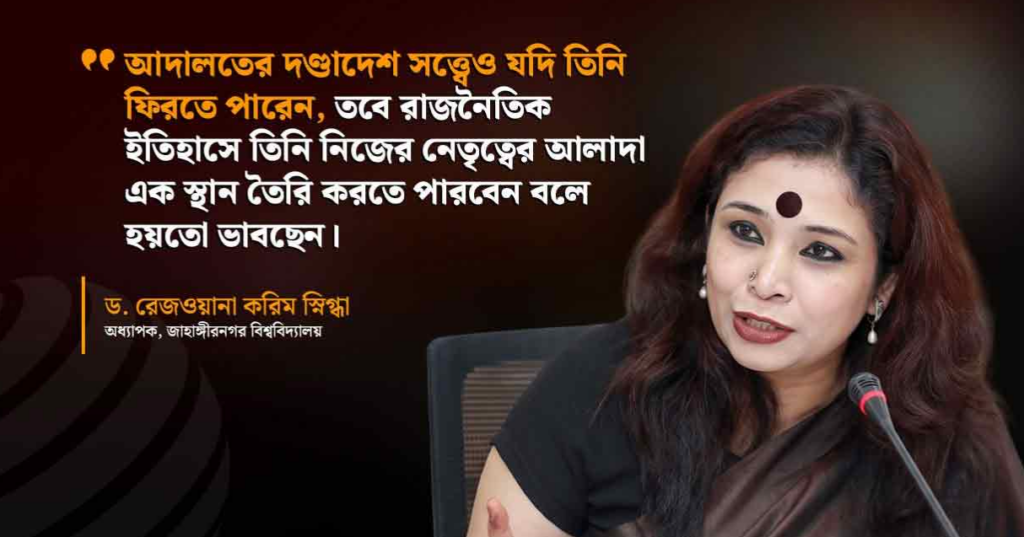
Professor Dr. Rezwana Karim Snigdha of the Department of Anthropology at Jahangirnagar University considers Sheikh Hasina’s announcement of her return to be a strategic political move.
She told Dhaka Post:
“I view this issue entirely from a political perspective. As the party leader, it is natural for her to make such statements in order to retain leaders and workers, keep their hopes alive and prevent the political death of the party. Essentially, this is a ‘political movement’ or strategic step by the Awami League.”
Although no clear political programme is visible at the grassroots level, the former prime minister’s announcement alone has created a kind of invisible fear among the administration, judiciary and opposition.
Politically, this can be considered a major strategic success for her. However, if she ultimately fails to turn the announcement into a reality on the ground, the confidence of party leaders and workers and the organizational morale of the party could be seriously damaged.
Highlighting the risks associated with this strategy, Professor Snigdha said:
“The timing of the announcement is important, but what is even more important is implementing it on the ground or clarifying it properly. Otherwise, the party’s core politics and its workers could suffer serious damage. Although preparations are being made through various meetings and seminars, if these efforts ultimately fail, it will become difficult for workers to trust any future statement made by Sheikh Hasina.”
If Sheikh Hasina ultimately does not return to the country, the trust among party leaders and workers and the organizational base could suffer serious damage.
Analyzing the thinking behind the proposed return, Professor Snigdha said:
“Sheikh Hasina really has little left to lose at this point. If she can return to the country despite the court verdict, she may be thinking that she could secure a unique place in political history as a leader. Perhaps she believes this is her last and most important opportunity to revive her personal image and her previous contribution to the country’s politics.”
Referring to the international context, she further said:
“Several international organizations and groups have expressed concern about the manner in which she was sentenced through the judicial process. She may be taking this bold decision by drawing psychological support from the international community. Because implementing such a decision while facing international pressure can be a difficult challenge for any government.”
As party leader, it is natural for her to make such statements to retain leaders and workers, sustain their hopes and prevent the political inactivity of the party.
This is essentially a “political campaign” or strategic position of the Awami League. However, if it is not implemented on the ground, it will become difficult to maintain the confidence of leaders and workers.
Dr. Rezwana Karim Snigdha, Professor, Jahangirnagar University
Referring to the complexities surrounding Sheikh Hasina’s stay in India and the extradition agreement, Professor Dr. Rezwana Karim Snigdha said:
“Bangladesh has a prisoner exchange or extradition agreement with India. However, a major legal question arises in this case. Generally, extradition is discussed when a person has been convicted by a court of another country or is a fugitive accused. But when Sheikh Hasina left the country and went to India, no verdict had been issued against her, nor had she gone there as a convicted accused. As a result, there are several administrative and legal complications regarding the implementation of this agreement.”
She further said:
“In this context, whether she ultimately returns to the country or not is itself as important as the question of her return. And if she does return, the process through which that becomes possible will be a very important chapter in Bangladesh’s political and judicial history.”
Government Position and Political Reality
Government representatives and political circles have continued to react to Sheikh Hasina’s announcement that she will return.
Home Minister Salahuddin Ahmed dismissed various rumors surrounding December, saying:
“Why are you so concerned about December? December is our month of victory. I do not believe that any evil force will be able to create instability in the country during this month.”
Regarding the former prime minister’s return and the trial process, he said clearly:
“Deposed Prime Minister Sheikh Hasina will not be given any opportunity to surrender. She will be arrested as soon as she returns to the country and the court’s verdict will be implemented in accordance with the law. We have always wanted her to return through the legal process. During the interim government’s tenure, letters and requests were sent to the Indian government under the extradition agreement. We want to bring her back to Bangladesh and ensure that her sentence is carried out.”
Prisoner Exchange Agreement
Manzil Morshed, a senior lawyer, said:
“We did have a prisoner exchange agreement between the two countries, but the name of the agreement is ‘prisoner exchange.’ To define it as such, Sheikh Hasina must first be a prisoner. Sheikh Hasina is not a prisoner in India; she is here as a guest. Therefore, unless India forcibly deports her, there is no scope for applying this agreement.”
On the other hand, regarding how realistic Sheikh Hasina’s return is in light of her cancelled passport, ongoing cases and court verdicts, Jagannath University Associate Professor of Political Science Mezbuh-ul-Azam Soudagar said:
“The process through which Sheikh Hasina wants to return to the country in December, and the expectations being placed by Awami League leaders and workers, are completely unrealistic. For workers to believe or become confused by such statements coming from the banned and opposition political camps is a sign of political immaturity.”
He further said:
“If Sheikh Hasina returns to the country, she will have to enter as a death row convict. Moreover, under the current circumstances, I see no real possibility of her returning to politics or being rehabilitated politically.”
Prisoner Exchange Agreement, India’s Role and Challenges Before the Government
Regarding Sheikh Hasina’s announcement that she would return, senior Supreme Court lawyer Manzil Morshed told Dhaka Post:
“It is not possible to say with certainty at this stage whether she will ultimately return to the country. However, since she has made the announcement, it can be assumed that she is preparing to come. She is not merely an individual; she is the top leader and president of a political party. Since she has neither resigned nor withdrawn from politics, she must be returning for political reasons.”
Speaking about the normality of legal cases in politics, he added:
“If you engage in politics, imprisonment, torture or litigation can happen; these are not unusual in politics. Just as the course of many cases changes with a change of power, current political leaders have also returned to the country after facing several cases in the past. Therefore, if there is a case, it will be dealt with through the legal process in court, and the court will make the final decision.”
Without appearing publicly herself, Sheikh Hasina has already caused concern among government policymakers, the administration and opposition political parties simply by announcing one decision.
At a time when her announcement alone has caused widespread concern, it must be acknowledged that her importance in the political equation remains intact.
Dr. Rezwana Karim Snigdha, Professor, Jahangirnagar University
The senior lawyer expressed doubts about the government’s ability to manage the situation and maintain law and order on the ground during Sheikh Hasina’s possible return in December.
He said:
“Even if the government allows her to return home, it is a major question how much the situation can actually be controlled. For example, if an opposition political party such as Jamaat, NCP or another group plans to surround the airport, while thousands of Awami League workers move toward the airport to welcome her, there would be an extremely high risk of clashes. If the government wants to avoid such a law and order situation, it could even take steps at the last moment to delay her return in order to avoid trouble.”
Disagreeing with the prevailing interpretation of the “prisoner exchange agreement” in relation to Sheikh Hasina’s extradition, Manzil Morshed said:
“Many people are talking about bringing her back under the prisoner exchange agreement, but I do not agree with this view. The name of the agreement is ‘prisoner exchange,’ which means that the concerned person must first have been formally convicted or imprisoned in another country. Sheikh Hasina is not in custody in India; she is living there as a guest of the Indian government.”
He further clarified:
“If a country wants to send her back, it has two options. Either the Indian government can formally ‘deport’ her to Bangladesh, which is a right available to any country under international law. But since she is a guest in India, the Indian government is not forcibly deporting her. And if India does not deport her and she is not a prisoner in India, there is no real legal opportunity or practical effectiveness in applying the prisoner exchange agreement to bring her back.”
Awami League Preparations and the Equation of Psychological Politics
Regarding the party’s current political preparations, a joint secretary of the banned Awami League told Dhaka Post:
“Our leader will return to the country, and we will also take to the streets with her. Meanwhile, our leaders and workers are being subjected to various forms of imprisonment and torture. If necessary, we are all prepared to go to jail. Keeping the leader’s return in mind, we are strengthening the organization and reinforcing every wing and affiliated organization. Regular online meetings and seminars are being held, and work is continuing to support leaders and workers detained across the country.”
He further said:
“We have prepared a specific ‘roadmap,’ and before returning home, the leader herself will inform the people of the country about her detailed plan through a press conference.”
Asked whether Sheikh Hasina’s announcement of her return had brought about any major change in politics, Dr. Rezwana Karim Snigdha told Dhaka Post:
“Although her announcement has not brought about any sudden qualitative change in grassroots politics, she has succeeded in creating a kind of invisible fear and anxiety at every level, from politics to the administration. Under the current circumstances, this is perhaps her greatest success or strategic achievement.”
She clarified that Sheikh Hasina is not currently in the country, and that even the Awami League has no public political activity at the grassroots level. Everything remains limited to online activities.
Without appearing directly in public, she has created deep concern and unease among government policymakers, the administration and opposition political parties simply by announcing one decision.
“Today, you called me to ask about this issue. That itself is the biggest political change at this moment. Some people may say that her past actions were unacceptable or that the Awami League has no right to engage in politics. But right now, when everyone is thinking about her announcement that she will return to the country, we must acknowledge that she still plays an important role in the political equation and that every decision she makes matters.”
with thanx: DHAKA POST